Google Ads for Contractors

Apex Operations: Google Ads for Contractors
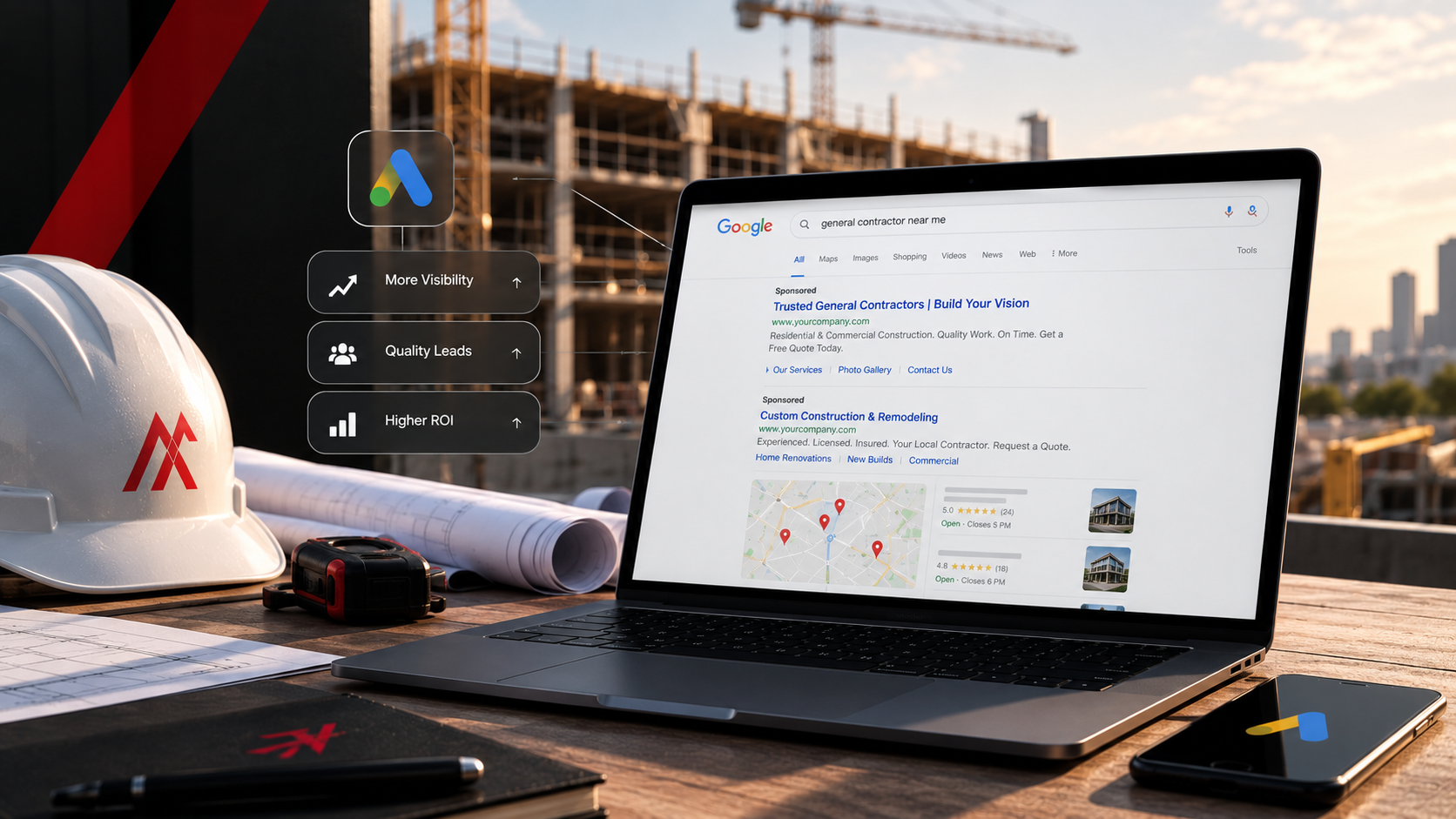
Are your ads generating leads—or simply costing you money?
If your construction company is investing in advertising without seeing enough qualified inquiries, the problem may not be your budget. It may be the strategy behind the campaign. Google Ads for contractors can put your business in front of people actively searching for your services, but successful campaigns require more than choosing keywords and setting a daily budget. The landing page, offer, location targeting, tracking, and follow-up process all influence whether clicks become real opportunities.
Why Google Ads for Contractors Matter
When a homeowner searches for a contractor, they are often looking for a solution they need now or are seriously considering. This makes search advertising different from channels where people may simply encounter a business while browsing.
Google Ads can provide contractors with immediate visibility for relevant searches while SEO builds organic visibility over time. However, paid traffic only becomes valuable when it produces qualified opportunities.
A successful campaign should therefore focus on the quality of leads, not simply the number of clicks or form submissions.
Understanding Google Ads for Contractors
Google Ads is a paid advertising platform that allows businesses to appear in search results when people search for relevant terms. Contractors can target specific services, locations, and types of searches that align with their ideal customers.
For example, a remodeling company may create campaigns around searches for kitchen remodeling, bathroom renovations, or whole-home remodeling in its service area.
The goal isn’t to appear for every possible search. It is to reach people whose needs, location, and project requirements make them a realistic fit for the business.
Best Practices for Google Ads for Contractors
A strong campaign should connect several important pieces:
- Target high-intent searches: Focus on searches that indicate someone is actively looking for your service.
- Use geographic targeting: Limit campaigns to areas your company can realistically serve.
- Create dedicated landing pages: Send visitors to pages relevant to the service they searched for.
- Write specific ad messaging: Clearly communicate the service, location, and value proposition.
- Track conversions: Measure calls, forms, consultations, and other meaningful actions.
- Review search terms: Identify irrelevant searches and add negative keywords when appropriate.
- Optimize continuously: Campaign performance should be reviewed and adjusted rather than left unchanged.
The objective is to create a connection between the search, advertisement, landing page, and sales process.
Common Google Ads Mistakes Contractors Make
Paid advertising can become expensive when campaigns are not properly structured.
Common mistakes include:
- Targeting overly broad keywords.
- Advertising outside the actual service area.
- Sending every visitor to the homepage.
- Focusing on clicks instead of qualified leads.
- Not tracking phone calls or form submissions.
- Failing to use negative keywords.
- Changing campaigns without enough performance data.
- Ignoring what happens after someone submits an inquiry.
One of the most important recommendations is to evaluate the entire customer journey. If an advertisement generates interest but the website is difficult to navigate or the sales team responds slowly, increasing the advertising budget will not necessarily solve the problem.
Google Ads Terms Contractors Should Know
You don’t need to become a PPC specialist to understand your campaigns. A few terms are especially useful:
- PPC: Pay-per-click advertising, where advertisers generally pay when someone clicks an ad.
- Keyword: A search term used to help determine when an advertisement may appear.
- Negative Keyword: A term that prevents ads from appearing for irrelevant searches.
- Cost Per Click (CPC): The amount paid for an individual ad click.
- Conversion: A valuable action, such as submitting a lead form or calling the business.
- Landing Page: A webpage designed to support a specific advertising campaign or offer.
Understanding these metrics helps contractors ask better questions about their advertising performance.
How Much Should Contractors Spend on Google Ads?
There is no universal advertising budget that works for every contractor.
The appropriate investment depends on factors such as:
- Service area
- Competition
- Average project value
- Available search demand
- Target services
- Lead conversion rate
- Sales close rate
A contractor selling high-value remodeling projects may approach advertising differently from a company focused on smaller service calls.
Rather than choosing a budget based solely on what competitors spend, contractors should work backward from their business goals and determine how much a qualified opportunity is worth.
How to Measure Google Ads Performance
Clicks and impressions can tell you whether people are seeing your ads, but they don’t tell the entire story.
Contractors should pay attention to:
- Cost per lead: How much advertising spend produces an inquiry.
- Lead quality: Whether inquiries match your ideal customer.
- Conversion rate: How frequently visitors take a desired action.
- Cost per qualified opportunity: How much it costs to generate a lead that actually fits the business.
- Close rate: How many qualified opportunities become customers.
- Revenue generated: The ultimate measure of whether advertising contributes to business growth.
- This approach shifts the conversation from “How many clicks did we get?” to “What did our advertising produce for the business?”
Real-World Application
Consider a custom remodeling contractor serving several cities.
Instead of running one broad campaign for “contractor,” the company could create separate campaigns around its most valuable services and target only the geographic areas it serves.
Each campaign could direct visitors to a relevant service page featuring completed projects, testimonials, project information, and a clear consultation request.
The company could then track which campaigns generate qualified consultations and which ultimately produce projects.
This creates a feedback loop that allows marketing decisions to be based on actual business performance.
Build a Google Ads Strategy That Supports Growth
Google Ads can be a powerful acquisition channel for contractors, but advertising should be connected to the rest of the marketing system. At Apex Operations, we help construction companies connect paid advertising with strategy, websites, SEO, conversion infrastructure, and lead management. If you’re investing in advertising but aren’t confident that your campaigns are producing the right opportunities, explore our Paid Advertising Services and contact Apex Operations to discuss a more structured growth strategy.
Frequently Asked Questions
1. Are Google Ads worth it for contractors?
Google Ads can be valuable for contractors when campaigns target relevant, high-intent searches and the business has a strong process for converting and following up with leads.
2. How do Google Ads work for contractors?
Contractors can create advertisements that appear when potential customers search for relevant services. The business pays for qualifying clicks according to the campaign’s bidding and pricing structure.
3. How much do Google Ads cost for contractors?
Costs vary significantly depending on the market, competition, keywords, services, location, and campaign structure. There is no fixed price for contractor Google Ads.
4. How long does it take for Google Ads to generate leads?
Paid search can begin generating traffic shortly after campaigns launch, but generating consistent qualified leads requires testing, conversion tracking, and ongoing optimization.
5. What keywords should contractors use for Google Ads?
Contractors should generally prioritize relevant searches that indicate strong intent to hire, such as specific services combined with geographic terms. The best keywords depend on the contractor’s services and market.
6. Should contractors send Google Ads traffic to their homepage?
Not necessarily. Dedicated landing pages or relevant service pages can provide a more focused experience because the content directly matches what the person searched for.
7. What is a negative keyword in Google Ads?
A negative keyword prevents an advertisement from appearing for searches that are not relevant to the business. This can help reduce wasted clicks and improve campaign relevance.
8. How can contractors get better-quality Google Ads leads?
Better targeting, specific service campaigns, geographic controls, relevant landing pages, conversion tracking, and clear qualification criteria can help improve lead quality.
9. Should contractors use Google Ads and SEO together?
They can complement each other. Google Ads can provide paid visibility while SEO focuses on building organic search visibility over time. Using both can give contractors multiple ways to reach potential customers.
10. Why should contractors work with Apex Operations for Google Ads?
Apex Operations approaches paid advertising as part of a broader growth system. By connecting advertising with websites, SEO, conversion strategy, and lead management, the goal is to help contractors generate qualified opportunities rather than simply increase website traffic.